Frequently Asked Questions
How long is each session?
Each session is one hour apart from an initial chronic symptom assessment, which is 1.5 hrs.
How many sessions will I need?
It’s completely natural to want clarity around this.
Because everyone’s experiences, symptoms, and history are different, it isn’t always possible to say exactly how many sessions you will need from the start.
The number of sessions can depend on things like:
The nature and duration of your symptoms
How your nervous system is currently responding
Your capacity for change and support between sessions
Many of my clients are experiencing longer-term patterns - such as anxiety, chronic pain, or overwhelm - which tend to benefit from a slightly deeper, more supportive process.
In these cases, we typically work together for around 6–12 sessions, allowing enough time to create meaningful, lasting change.
Rather than just managing symptoms, we work together to understand what your symptoms are communicating. This process can take time… but it leads to deeper, more lasting change.
What if I am worried about the cost?
Investing in your health is a big decision. If budget is a concern, there are plenty of free resources on my website and through my mailing list to support your journey. I offer packages of sessions that offer a small discount on the per-session fee, and and also sessions on a per-session basis. Find out more here.
Do you offer Pain Reprocessing Therapy (PRT)?
The core principles of Pain Reprocessing Therapy (PRT) are included in my SIRPA training. I integrate the principles of PRT with other therapies to address the biological, psychological, emotional and behavioural factors that cause symptoms to persist.
What is PRT?
PRT helps people retrain the brain to evaluate more accurately the sensory information it receives, particularly when pain is being maintained by the brain from misguided fear of ongoing tissue damage.
I have anxiety and depression. Is this suitable for me?
Yes absolutely. It is common that my clients also have anxiety and/or depression, and this was my speciality before helping people with chronic pain.
If your depression is severe, I would encourage you to consult your GP or a mental health professional for additional guidance.
What does a typical session look like?
Each session is tailored to you — your goals, your experiences, and what you need in that moment.
Our work is collaborative. I come with a clear intention for the session, while also staying flexible and responsive to anything that may have come up for you since we last met.
In our initial sessions, we’ll explore what you’d like support with, what (if anything) has already helped and how you prefer to work.
I’ll gently guide you with what I feel may be most helpful, while always listening to you and adapting to what feels right for you.
Depending on your needs, sessions may include:
Practical tools to help you manage anxiety or panic
Pain reprocessing or Somatic tracking
Gentle mind-body or somatic work
Hypnotherapy or guided visualisation
Mindfulness and nervous system regulation techniques
Exploring patterns and underlying causes of your symptoms
I may also suggest simple practices or tools for you to use between sessions, to support your progress.
How frequently will I need sessions?
Sessions are usually best when spaced weekly or fortnightly.
This allows enough time for changes to begin integrating, while still maintaining momentum and support.
We can always adjust the pace depending on your needs, availability, and what feels manageable for you.
Do you only accept female clients?
No, I am happy to see all clients, irrespective of gender. It's just that I specialise in seeing women.
Do you see children?
Yes, I do. I generally work with children of age 13 upwards, though have worked with children over the age of 5.
What Qualifications do you have?
I am trained in Hypnotherapy, Mindfulness, EFT, NLP, Embodied Processing, and am a SIRPA Practitioner. I also have a Health Psychology MSc. Please read more about my qualifications and experience here.
General Questions About Sessions
My pain is so severe - surely there must be something physically wrong for me to be in this much pain?
Our bodies are far more resilient than most people think. In fact, numerous studies over the past two decades have found little evidence linking poor posture, structure, or biomechanics to musculoskeletal pain. Chronic pain is primarily driven by our body’s automatic, unconscious, and primitive survival response to perceived threats. While we may not encounter life-threatening situations as often today, our central nervous system still works to protect us. The greater the perceived stress or threat, the more intense the response - manifesting as pain.
I was stressed when my pain started, but I’m not now and yet I can’t get rid of the pain. Why is that?
Unfortunately, the fear and frustration caused by pain and the struggle to recover can keep the pain cycle going. Over time, the nervous system becomes more sensitive, making the pain response easier to trigger. To break this cycle, it’s important to use strategies that help retrain the nervous system while also identifying and addressing any underlying triggers, both past and present.
I have tried every treatment you can think of, but I still have pain. How do I know that you can help?
I have been there and it is frustrating! However, this work addresses the real cause of your symptoms and the Boulder Back Pain study found 66% were pain free or nearly pain free with a mind-body approach, so we know this work can be very affective. I find that by the end of our sessions, the great majority of my clients are on their way to recovering or have symptom recovery.
I have a really busy life and am not sure if I can commit much time. What do you suggest?
The fact that you're so busy may well be one of the causes of your pain. If we don’t take time out to unwind, our body may find other ways to release built-up stress - often through pain. Many strategies I teach can fit easily into your daily routine. However, if you don’t allow yourself any time to pause within a hectic schedule, progress may be limited.
My MRI scans showed that there is some degeneration, so how can you say that this isn’t causing my pain?
There are numerous studies demonstrating that just as many people who don’t have pain have degeneration. This is a normal sign of ageing and rarely linked to pain. Take a look at these studies.
When my pain came on I wasn’t feeling stressed, so maybe my pain is real?
Your pain is real, even if it has an emotional cause. If serious conditions like cancer, infections, fractures, or autoimmune disorders have been ruled out, chronic pain is almost always linked to stress. This is incredibly common but often misunderstood. Sometimes, pain is triggered by an event you don’t consciously remember—perhaps an old emotional memory or an issue your brain perceives as ‘dangerous’ or ‘inappropriate.’ In response, your nervous system activates a survival mechanism, creating pain as a form of protection. By understanding these patterns, you can begin to break free from the cycle and regain control.
I hurt my back a while ago and the pain never went. Surely I must have damaged it and that’s why it’s no better?
Even if there was an injury, it would have healed within weeks rather than lingering for months. We now understand through recent science that it is more likely that there was some inner conflict at play when the pain started. Perhaps you felt resentful, the activity triggered an unresolved past issue, or you were overwhelmed with everything else going on in your life.
I have a situation that is causing me enormous stress and there is no way out of it, so if my pain is stress-induced how can you help me?
Feeling disempowered and unable to see a way forward can make things even more challenging. This sense of inner turmoil can actually fuel pain, creating a cycle that feels hard to escape. However, it’s important to remember that stress is said to be only 10% about what happens to us and 90% about how we respond. The goal of our sessions is to help you navigate life with less resistance. I provide practical strategies for managing ongoing stress, helping you break free from the pain-stress cycle and regain control of your well-being.
Questions About Symptoms
Where are you based and do you see International clients?
I can see you in the comfort of your home, or mine. I have a quiet room in Horley, Surrey (UK). I am also insured and able to see you wherever you are in the world, over the internet.
I find this works really well, even for hypnotherapy and somatic work.


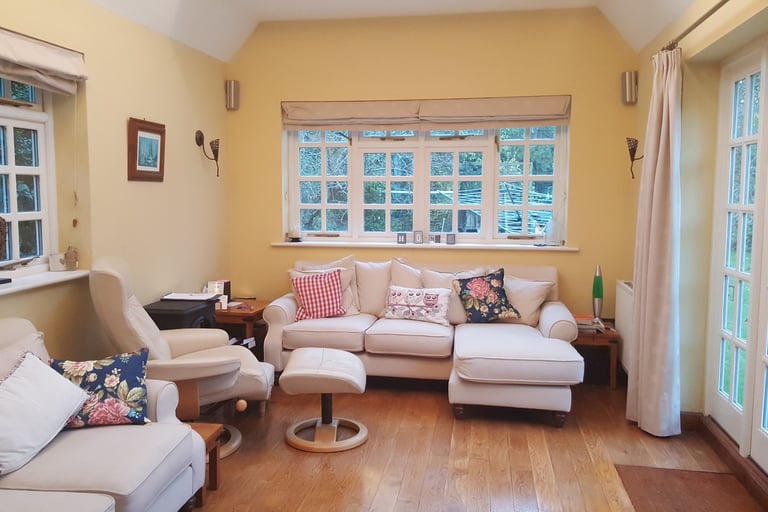
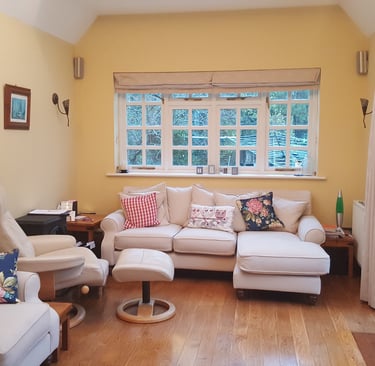
My quiet room in Surrey, UK.
MH Wellbeing, Maria Hancock MSc GQHP
Specialist in Anxiety, Stress and Chronic Symptoms
Trauma-Informed Somatic Therapist, Hypnotherapist, Mindfulness Teacher, SIRPA Pain Recovery Practitioner
Local areas: Horley, Reigate, Redhill in Surrey and Crawley, Horsham, Copthorne in West Sussex. English Speaking Online Therapy.